Who Should Be on the Team?
Imagine we are about to set up a new team and now think about the question who should be on that team. Which skills, attitudes, personality traits do we need, in order to set the team up for success? The first thing that probably comes to mind are technical skills. If we intend to build an iOS App, we will need people who are skilled and experienced in iOS development, and probably also someone with backend and frontend experience. A common misconception, though, is that technical skills are all that matters. In his book Team Intelligence, Jon Levy puts it eloquently when he writes: “Talent is the price of entry for being on a team, but no guarantee for a good team.” The reason for this is that teams fail more from coordination breakdowns than from lack of individual talent. So we also need to look out for skills other than technical ones that help prevent such breakdowns. Let’s call them social abilities.
Social Abilities
When talking about social abilities, people will inevitably bring up things like communication, feedback and conflict resolution skills. Of course these are important for teamwork, no argument here. However, one issue is that they can be quite vague, because they are so general. What’s more, there are other, more specific skills that are highly relevant but widely overlooked. Two that recently caught my attention are collective orientation and social sensitivity.
Collective Orientation
Collective orientation shows high predictive power for team effectiveness,¹ but it is quite unknown in software development (at least I have never heard someone talk about it). Collective orientation encompasses the belief that teams are effective, the willingness to work in a team and to put team goals over individual goals. But wait a minute! Isn’t that just fancy words for being a good team player? Maybe. But collective orientation is specific, it can be measured, there’s a ton of research on it, and it is less loaded (who would admit they are not a good team player?)
High collective orientation is critical, because it promotes information sharing, backup behavior (helping overloaded teammates), trust, and adaptive coordination - the team’s ability to flexibly adjust who does what, when, and how. And by the way: The impact of collective orientation gets stronger when tasks are highly interdependent, environments are uncertain, time is of the essence, and teams are working cross-functionally. Sounds familiar?
Collective orientation is an attitude that people bring to the table when joining a team. It’s more stable than skills, which often can be learned rather quickly. But it is less stable than personality traits, and there are strong indications that collective orientation can be increased by providing group feedback and a positive team work experience.
Social Sensitivity
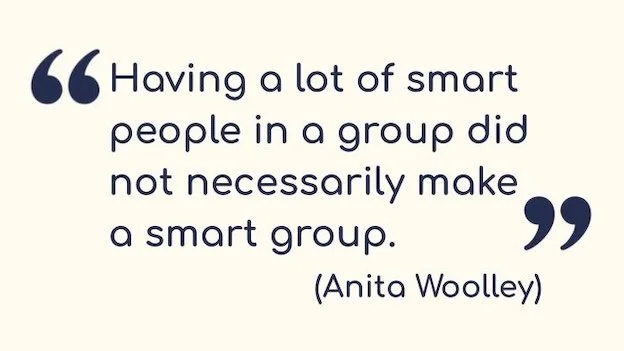
Anita Woolley and her colleagues conducted research on what they call collective intelligence, which in turn is a strong predictor for team effectiveness. Collective intelligence is the equivalent of IQ, but on a team level. It’s the “general ability of the group to perform a wide variety of tasks.”² Interestingly, collective intelligence is not just the average IQ of members, nor is it determined by the highest individual IQ in the group. Also other factors that we often believe are critical, e.g. personality types, are not what really matters. Instead, the researchers found that social sensitivity is the strongest predictor of collective intelligence.It’s defined as “the ability to accurately infer others’ emotions and mental states.” That may sound a little bit strange. Why would that be critical for good team work? It turns out that social sensitivity enables a whole range of behaviors that are beneficial for effective team work: better turn-taking, reduced dominance, faster repair of misunderstandings, more accurate interpretation of subtle cues, and better timing in conversation.
Social sensitivity is a relatively stable individual capability, which might be hard to change. So it’s good to have an eye on it when hiring new folks into our organization. Turn taking behavior is a good indicator of social sensitivity, so this might be something to watch out for. And if you want to take a short cut: Just hire more women, as Woolley found that women consistently showed higher scores in social sensitivity tests.
Who Should not Be on the Team?
Although it’s not a new idea, it’s worth repeating that there’s a certain type of people we don’t want on our teams, no matter how good their technical skills might be. They are often called “toxic employees”. Ruth Wageman uses the less drastic term derailers, and she defines them as people who
frequently complain about and criticize others in public;
bring out the worst in other members;
attack people instead of criticizing the issues;
talk in the hall but not in the room;
constantly disagree with everyone and everything;
display chronic discrepancies between public words and private actions;
claim to understand their behavior but seem unable to change.³
We have probably all met one or several derailers in our careers. When I bring up this issue in my training classes, leaders often report that they are aware of their derailers, but they would have a hard time letting them go. The most common reasons are that they “get stuff done” (at least in the short term) and that they seem indispensable. Unfortunately, derailers are often also good at charming or even manipulating people to create and amplify this impression.
As understandable as all this might be, removing derailers is a clear case of “ripping off the bandaid”. They are undermining teamwork and the longer we wait, the worse it gets. Interestingly, those leaders who have done just that (ripping off the bandaid) unequivocally report that it was definitely the right call, things did not fall apart, and their only regret is that they wish they had done it earlier.
Now What?
Creating high-performing teams is not a simple task, many different aspects come into play. Social abilities are one of them. We should talk less about general, often vague concepts like “communication skills” and pay more attention to critical, yet little known concepts like collective orientation and social sensitivity. Although there’s no playbook for how to utilize these in practice, there’s a couple of things we can try in our daily work:
Create more awareness for these concepts in our organization;
Re-evaluate our hiring processes, so we can screen for these abilities. Stop asking “are you a good team player?”
Observe turn taking behavior;
Create positive team experiences (yes, that’s easier said than done and probably requires a post on its own);
Provide team-based feedback (focusing on how the team is doing as a whole, not the individual members);
Hire more women.
__________
¹ Salas et al (2010) Collective orientation and team performance: development of an individual differences measure.
² Woolley et al (2010) Evidence for a collective intelligence factor in the performance of human groups.
³ Wageman et al (2008): Senior Leadership Teams. Chapter 4.
