Thoughts on Company Values
Imagine you are walking into an office you have never been to before. Maybe you are visiting a friend who has just started their new job here. You step into the elevator and discover a poster which says:
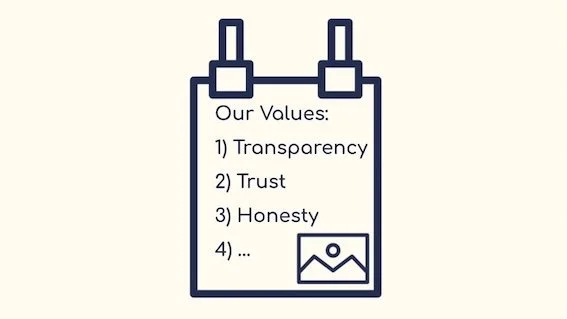
“We are proud of our company values: 1) Transparency, 2) Trust, 3) Honesty, 4) …”
Would your reaction be: “Oh wow, this must be a cool company that really values things like transparency and trust!”? Or would you roll your eyes and sigh? Granted, there are many more possible reactions, but having talked to a bunch of folks about this topic lately, I came to realize that many of them have a more negative reaction to such a poster. Is it because they don’t value transparency and trust? Certainly not! Is it because they don’t believe in the power of company values? Probably also no. The reason is that they have seen and experienced first hand how companies often don’t get the intended effects like motivating and energizing employees. Quite the opposite, the worst case is that they lead to jokes and cynicism. Having been part of numerous vision and value workshops - some as a facilitator, some as a participant - I have come to realize that there’s a bunch of anti-patterns which I want to share.
Anti-pattern 1: Aspirational Values
One of the biggest pitfall when running value workshops is to simply ask a group: “What are our company values?” If we do so, we will almost certainly end up with aspirational values: the values we would like to have. But what we are really looking for are the values we already have in our organization. We might later decide that we don’t like them and we would like to change them, but that’s a whole different can of worms. The activities we run in our workshops should be more about exploration and less about goal setting.
A good approach for this, I find, is to use story telling: Ask everyone to come up with 2-3 little stories (they can be very small) that are “typical us” or “so much our organization”. After everyone has shared their stories, we can then cluster them, look for patterns and extract values out of them.
Anti-pattern 2: Focusing on the Artefact
Maybe you have heard the adage “Planning is useful, the plan is useless.” Although exaggerated, I find there’s a lot of truth in this, and we could say something very similar about company values: The process of coming up with values (especially the conversations we are having along the way) is highly valuable. The artifact that comes out of this process - be it a poster, a document or a slide deck - often has limited value. Yet we often focus very much on the artefact and expect that once we put those posters on our walls, magic will happen and people will change their behaviors. Underneath this lies a somewhat flawed assumption: A group of leaders comes up with the values, so that employees can change their behavior. But it doesn’t work that way. The values should first and foremost be an instrument for the leaders in an organization to check and adjust their own behavior. Only if they do this first can we expect change in the rest of the organization. A good question to bring up in leadership conversations is: “How does this decision / behavior reinforce our company values?” This, I find, is a better use of company values then just asking people to comply with them.
Anti-pattern 3: Generic Values
One reason why some people have a negative reaction to “yet another poster with company values” is that the values are often so abstract and generic that they don’t really tell us anything. Sure, everybody likes “Transparency”, “Trust”, “Innovation” (is that even a value?) etc. But they are so generic that almost every company on this planet could identify with them. And, even worse, the values alone make it hard to base decisions and behaviors on them. What helps with this is to add short descriptions or examples that connect them to actual behaviors, eg “Transparency: We internally provide access to company data as much as possible (within legal boundaries), because we believe transparency helps our employees do better work. We even do this at the risk of some information being leaked to our competitors.” If we frame it like this (and it doesn’t have to be that radical), it makes “Transparency” much more tangible and urges us to put our money where our mouth is (meaning: we are aware that radical transparency comes with a price).
Anti-pattern 4: Involving Everyone in Everything
Of course we want buy-in from as many people as possible, and one way of getting this buy-in is to involve them in the process of coming up with the company values. At the same time, running workshops with a large group of people quickly becomes an exercise in frustration and can slow the whole process down. A good way of dealing with this tension is to form a small core group that runs the actual workshops, but each participant elicits input from a variety of people before and between the workshops. In my experience, a lot of people like to be involved in such activities (and they might even become detractors if they are not involved), but that does not mean that they need (or want to) be part of every step along the way. If we ask them for their ideas and opinions early on (and not after key decisions are being made) and keep them posted about the progress, we can keep the process slim and everybody happy.
Lastly, we should be aware of wordsmithing. Discovering company values and agreeing on their implications is a great activity for teams. Wordsmithing is not. So my recommendation is to only create a raw version as a group and then delegate putting it into nice words to one or two people.
